
Alex Washington · 18 October 2026
Optimizing Query Performance in Large-Scale Encrypted Collaborative Repositories Used by Multinational Corporations
Multinational corporations maintain extensive encrypted collaborative repositories that store sensitive documents, project files, and operational data across distributed teams, and these systems require specialized approaches to maintain both security and efficient data retrieval. Researchers have examined methods that balance encryption overhead with query speed, particularly in environments where multiple jurisdictions impose varying compliance requirements on data handling.
Core Challenges in Encrypted Query Processing
Encryption schemes protect data at rest and in transit, yet they introduce computational costs during search operations because traditional indexing methods cannot directly access plaintext values. Teams working on these repositories often encounter latency spikes when executing full-text searches or range queries over millions of records, and studies show that unoptimized systems can experience query times extending several times longer than their unencrypted counterparts. Data released in October 2026 by industry analysts indicated continued growth in repository sizes, with average multinational setups exceeding petabyte-scale storage while supporting concurrent access from thousands of users across continents.
Homomorphic encryption permits certain computations on ciphertext without decryption, allowing basic arithmetic operations that support aggregate queries, whereas order-preserving encryption enables range comparisons yet reveals some ordering information that must be managed carefully to avoid leakage. Observers note that selecting the right encryption primitive depends on the query workload, since each method carries distinct performance profiles documented in cryptographic research papers.
Indexing and Partitioning Strategies
Developers implement inverted indexes adapted for encrypted tokens, where each keyword maps to a set of encrypted document identifiers that support efficient intersection during multi-term searches. Partitioning data by geographic region or access frequency helps reduce the scope of each query, and experiments conducted at research institutions have demonstrated that locality-aware sharding can cut average response times by directing requests to the nearest node holding relevant encrypted chunks. Those who've studied these architectures report that metadata tags stored alongside encrypted payloads allow dynamic rebalancing without exposing content.
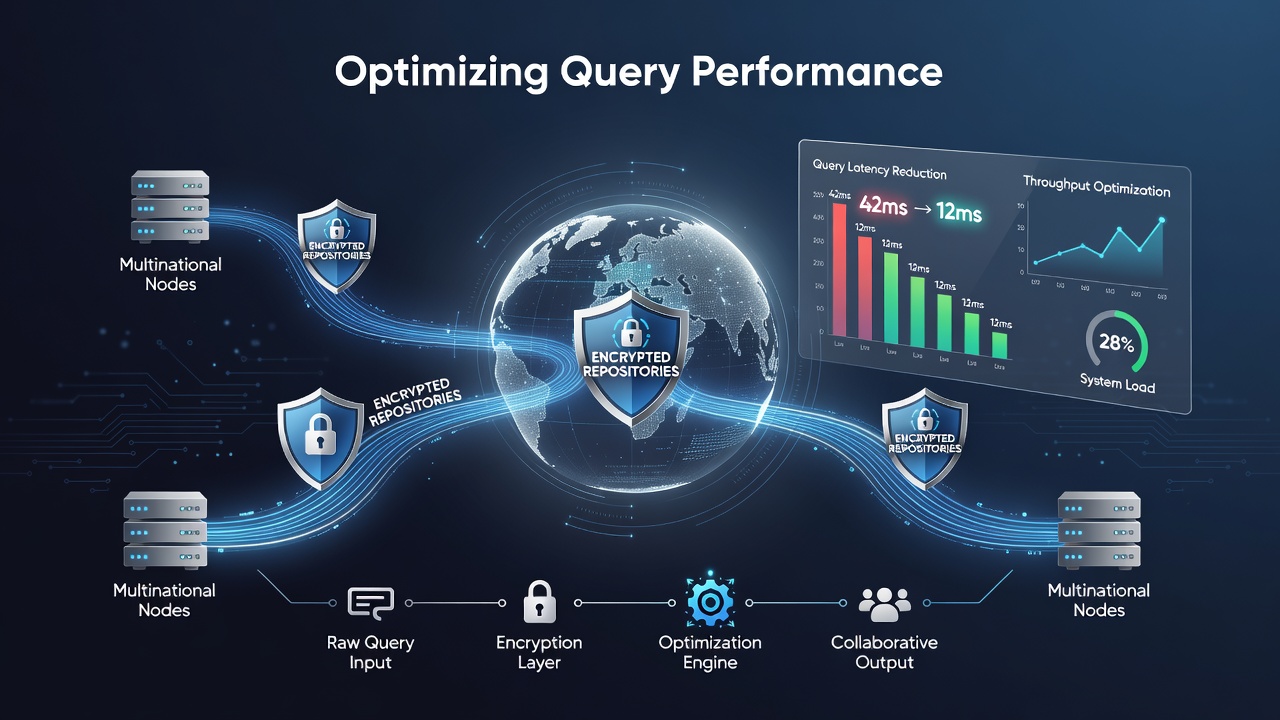
Cache layers positioned between the application and the storage backend store frequently accessed encrypted result sets, while invalidation protocols ensure consistency when documents receive updates from collaborative edits. According to guidelines published by the National Institute of Standards and Technology, organizations benefit from combining these caches with bloom filters that quickly eliminate non-matching encrypted entries before more expensive cryptographic operations begin.
Distributed System Considerations
Multinational setups route queries through edge nodes that apply local filters before forwarding remaining encrypted payloads to central repositories, and this hierarchical approach limits the volume of data traversing wide-area networks. Researchers at academic centers have measured how network latency compounds with cryptographic processing, leading to hybrid models that perform lightweight operations closer to users while reserving heavy computations for specialized hardware accelerators. ENISA reports on cybersecurity practices highlight the role of standardized key management protocols that rotate encryption keys across regions without interrupting ongoing collaborative sessions.
Monitoring tools track query patterns in real time, feeding data into adaptive optimizers that rewrite requests to favor indexes with lower decryption overhead. One case study involving a global manufacturing firm revealed that adjusting partition sizes based on access logs produced measurable reductions in average query duration across their encrypted document stores.
Performance Measurement and Tools
Benchmark suites developed by standards bodies evaluate encrypted query systems using workloads that mimic enterprise collaboration, including concurrent edits, versioned document retrieval, and cross-team searches. Metrics such as throughput under load and tail latency help teams compare different encryption configurations, and open-source libraries now incorporate these benchmarks to guide configuration choices. Those implementing the systems often integrate these tools into continuous integration pipelines so performance regressions surface early during development cycles.
Conclusion
Techniques for optimizing queries in large-scale encrypted collaborative repositories continue to evolve alongside advances in hardware acceleration and cryptographic primitives, providing multinational corporations with practical paths to maintain both security and responsiveness. Implementation decisions rest on workload analysis, regulatory constraints, and measured trade-offs documented across multiple research sources.