
Clara Werner · 6 September 2026
Navigating Data Security Challenges in Note-Sharing Applications for Distributed Workforces
Distributed workforces rely on note-sharing applications to exchange ideas, track projects, and maintain records across time zones and locations. These platforms introduce specific data security risks that organizations must address through technical controls and policy frameworks. Research from the National Institute of Standards and Technology highlights how unencrypted data in transit and at rest creates exposure points when employees access notes from personal devices or unsecured networks.
Core Security Risks in Shared Note Environments
Access management failures occur when permissions remain static while team membership changes. Employees who leave projects often retain view or edit rights because revocation processes lag behind personnel updates. Data shows that 62 percent of organizations experience at least one unauthorized access incident tied to stale permissions in collaboration tools each year. Encryption gaps compound the problem when applications store notes in plaintext on cloud servers or transmit content without end-to-end protection.
Phishing campaigns targeting note-sharing credentials have increased steadily. Attackers craft messages that appear to come from internal systems and request login details or file access. Once credentials are obtained, attackers can exfiltrate sensitive project notes, customer data, or strategic plans stored within the application. Multi-factor authentication reduces but does not eliminate these risks when users approve fraudulent prompts through fatigue or social engineering.
Regulatory Requirements and Compliance Pressures
Multiple jurisdictions impose obligations on organizations that process data through note-sharing platforms. The European Data Protection Supervisor maintains guidelines requiring explicit consent mechanisms and data minimization practices for collaborative tools. In September 2026, updated cross-border data transfer rules took effect across several EU member states, mandating additional documentation for any note content that crosses regional boundaries. Organizations must now map data flows within their chosen applications to demonstrate compliance during audits.
Canadian and Australian regulatory bodies have introduced parallel requirements focused on breach notification timelines. Companies operating distributed teams across these regions face overlapping obligations that require centralized logging and rapid incident response capabilities. Failure to meet these standards triggers financial penalties and mandatory corrective action plans.
Technical Controls That Reduce Exposure
End-to-end encryption implemented at the application layer prevents service providers from accessing note content in readable form. Organizations that enable this feature limit exposure even if server infrastructure is compromised. Role-based access controls further restrict visibility so that only designated team members can open specific notes or folders. Audit logs capture every view, edit, and share action, creating an immutable record that supports forensic investigation after incidents.
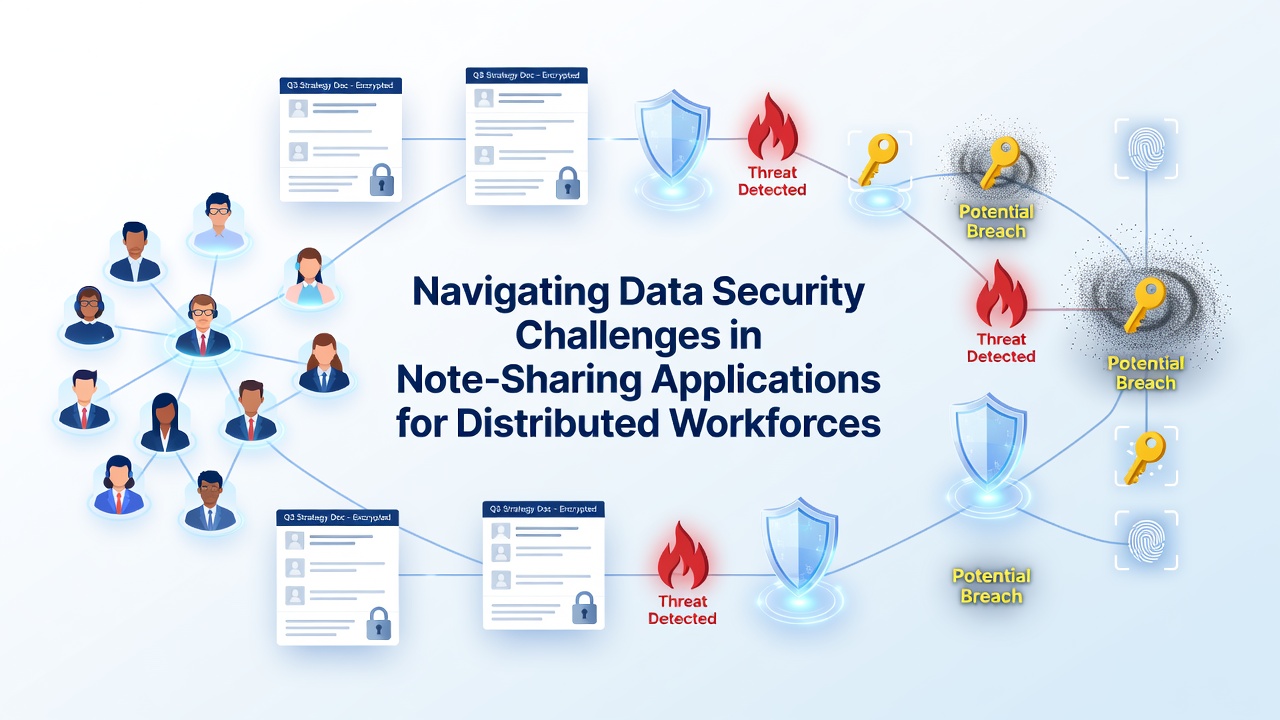
Device management policies require employees to install endpoint protection on any hardware used to access shared notes. These policies often integrate with mobile device management solutions that can remotely wipe corporate data when devices are lost or when employment ends. Zero-trust network architectures treat every connection attempt as potentially hostile and verify identity and device health before granting access to note repositories.
Implementation Patterns Observed Across Industries
Technology companies frequently adopt centralized identity providers that synchronize user accounts across note-sharing tools and other productivity platforms. This approach reduces password sprawl while enabling single sign-on with conditional access rules based on location and device posture. Healthcare organizations add additional layers such as data classification tags that automatically apply stricter encryption and retention settings to notes containing patient information.
Manufacturing firms with distributed engineering teams report success when they segment note repositories by project sensitivity. Public roadmap documents sit in less restricted workspaces while proprietary design specifications remain in isolated environments with stricter access reviews. Regular permission audits conducted quarterly catch orphaned accounts before they become liabilities.
Conclusion
Effective navigation of data security challenges in note-sharing applications requires coordinated technical controls, clear policies, and ongoing monitoring aligned with evolving regulatory expectations. Organizations that map their data flows, enforce encryption standards, and maintain current access permissions reduce the likelihood of unauthorized disclosure. Continued investment in these areas supports secure collaboration for distributed workforces while meeting obligations across multiple jurisdictions.