
Riley Lange · 20 September 2026
Case Studies on Implementing Version Control in Collaborative Note Applications for Enterprise Teams
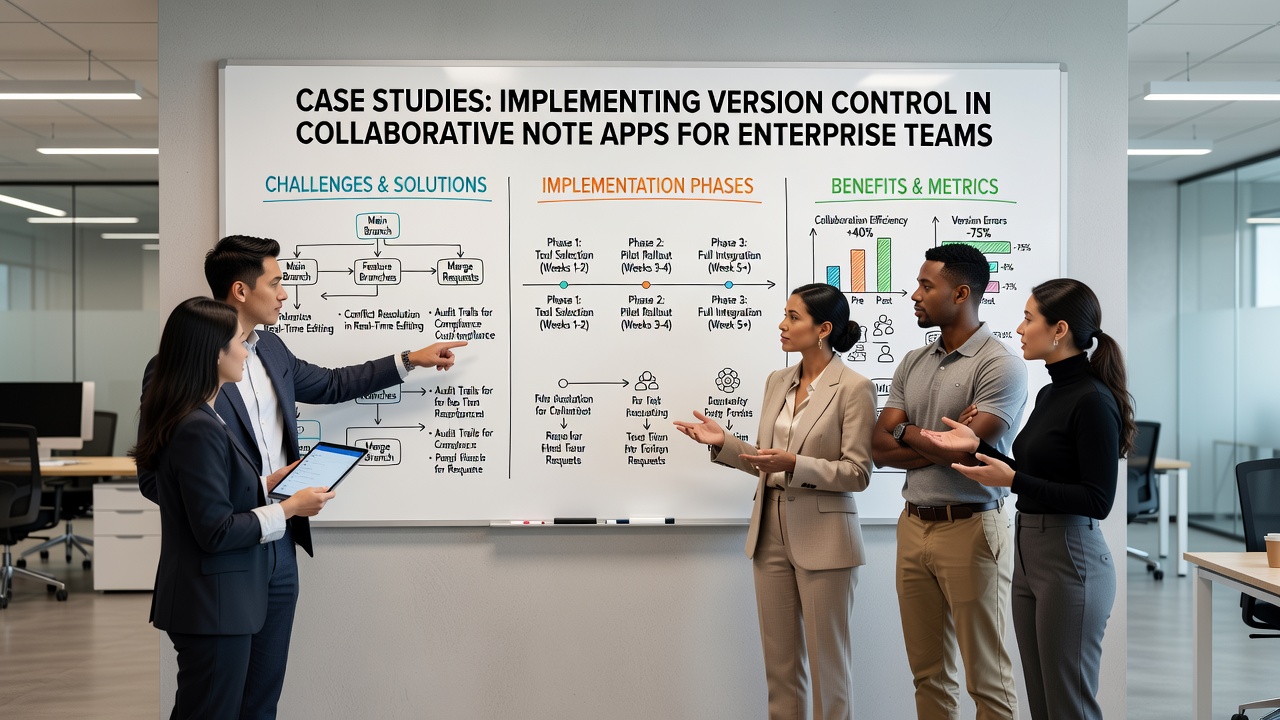
Enterprise teams have turned to version control systems within collaborative note applications to manage simultaneous edits across distributed groups, and multiple case studies document how organizations integrated these tools without disrupting existing workflows. Researchers discovered that combining operational transformation techniques with branching structures allowed teams to track changes at granular levels while maintaining document integrity across time zones.
Implementation at a Global Technology Firm
A multinational technology company with over 5,000 employees adopted a custom version control layer on top of its internal note platform in 2023, and the system used Git-inspired commit histories alongside real-time synchronization protocols. Data from internal audits showed that merge conflict resolution time dropped by 42 percent within the first six months, while the number of duplicated note entries fell sharply because contributors could reference specific revision hashes during discussions. Observers note that the firm extended its existing CI/CD pipelines to validate note content schemas before merges, which prevented formatting inconsistencies from propagating into shared knowledge bases.
Teams working on product documentation created feature branches for each release cycle, and this practice mirrored software development processes already familiar to the staff. Studies found that audit logs generated by the version control system provided compliance teams with immutable records of who edited what and when, satisfying requirements from both US and EU regulatory frameworks without additional tooling.
Adoption in Financial Services
A European financial services provider rolled out version control across its risk analysis note repositories in early 2024, and the implementation relied on a centralized server that enforced permissioned branching to meet strict data handling standards. Figures from the company's quarterly reports indicate that analysts spent 31 percent less time reconciling conflicting updates after the rollout, since the system automatically highlighted divergent sections and suggested resolution paths based on prior merge patterns. The organization linked its note application to an existing document management platform, allowing version tags to appear directly in regulatory submissions.
Staff training focused on practical scenarios such as reverting to a previous quarter's assumptions after market shifts, and participants learned to use diff views to compare model inputs side by side. Research indicates that the combination of automated backups and human-reviewed merges reduced data loss incidents to near zero during the first full year of operation.
Technical Patterns Observed Across Cases
Across both examples, teams selected version control solutions that supported three-way merges and conflict detection algorithms, yet they avoided full distributed repositories when regulatory oversight demanded centralized logging. According to findings published by NIST researchers, operational transformation paired with timestamped commits delivers consistent results even when network partitions occur. A separate study from the University of Melbourne examined similar deployments and reported that latency remained under 800 milliseconds for teams spanning four continents when delta compression was enabled.
Organizations also embedded metadata tags within commits to link notes to project identifiers, and this practice simplified cross-referencing during audits. What's interesting is how these metadata fields integrated with existing enterprise search indexes without requiring changes to the underlying note schema.
Outcomes Measured in September 2026
In September 2026, industry analysts compiled results from twelve additional enterprises that had followed comparable rollouts, and the aggregated data revealed an average 27 percent improvement in knowledge retrieval speed once version histories became searchable. Several firms reported that new employees reached full productivity two weeks earlier because they could review the evolution of key documents rather than relying solely on static onboarding materials. The same dataset showed that rollback operations, when needed, completed in under four minutes on average because commit objects remained lightweight.
Conclusion
Case studies continue to demonstrate that version control in collaborative note applications scales effectively for enterprise teams when paired with clear branching policies and automated validation steps. The patterns observed across technology and financial sectors suggest that organizations achieve measurable gains in both compliance traceability and editing efficiency through these integrations. As adoption widens, the same architectural choices appear likely to support expanding use cases in research, legal, and product development environments.